
ISSN: 2161-0460
Journal of Alzheimers Disease & Parkinsonism
天美传媒 Access
Our Group organises 3000+ Global Events every year across USA, Europe & Asia with support from 1000 more scientific Societies and Publishes 700+ 天美传媒 Access Journals which contains over 50000 eminent personalities, reputed scientists as editorial board members.
天美传媒 Access Journals gaining more Readers and Citations
700 Journals and 15,000,000 Readers Each Journal is getting 25,000+ Readers
Citations : 4334
Indexed In
- Index Copernicus
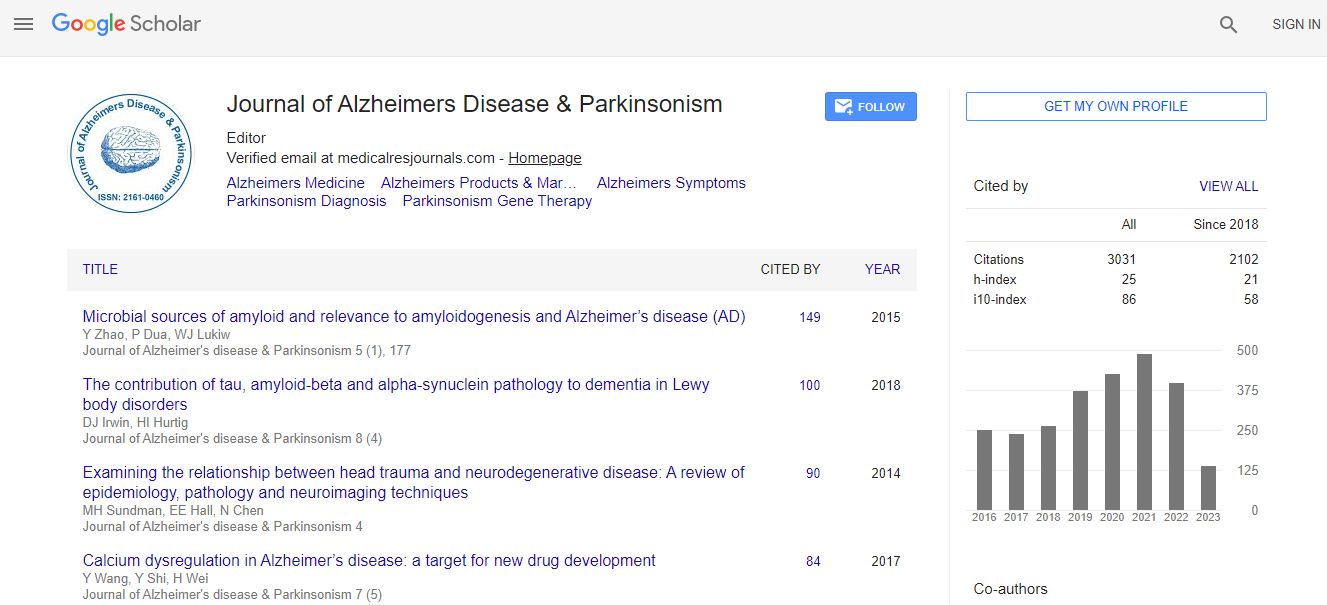
- Google Scholar
- Sherpa Romeo
- 天美传媒 J Gate
- Genamics JournalSeek
- Academic Keys
- JournalTOCs
- China National Knowledge Infrastructure (CNKI)
- Electronic Journals Library
- RefSeek
- Hamdard University
- EBSCO A-Z
- OCLC- WorldCat
- SWB online catalog
- Virtual Library of Biology (vifabio)
- Publons
- Geneva Foundation for Medical Education and Research
- Euro Pub
- ICMJE
Useful Links
Recommended Journals
Related Subjects
Share This Page
Effects of muscarinic receptors blocking on recovery of tacrine-loaded magnetic chitosan in brain damaged Rat by stz
2nd International Conference on Alzheimers Disease and Dementia
Simin Mahaki Zadeh, Kousar H M E Noori, Homa Kushesfahani, Gholamreza Hasan Zadeh and Mohammad Sharif Zadeh
Accepted Abstracts: J Alzheimers Dis Parkinsonism
DOI:
