
ISSN: 2161-0681
Journal of Clinical & Experimental Pathology
天美传媒 Access
Our Group organises 3000+ Global Events every year across USA, Europe & Asia with support from 1000 more scientific Societies and Publishes 700+ 天美传媒 Access Journals which contains over 50000 eminent personalities, reputed scientists as editorial board members.
天美传媒 Access Journals gaining more Readers and Citations
700 Journals and 15,000,000 Readers Each Journal is getting 25,000+ Readers
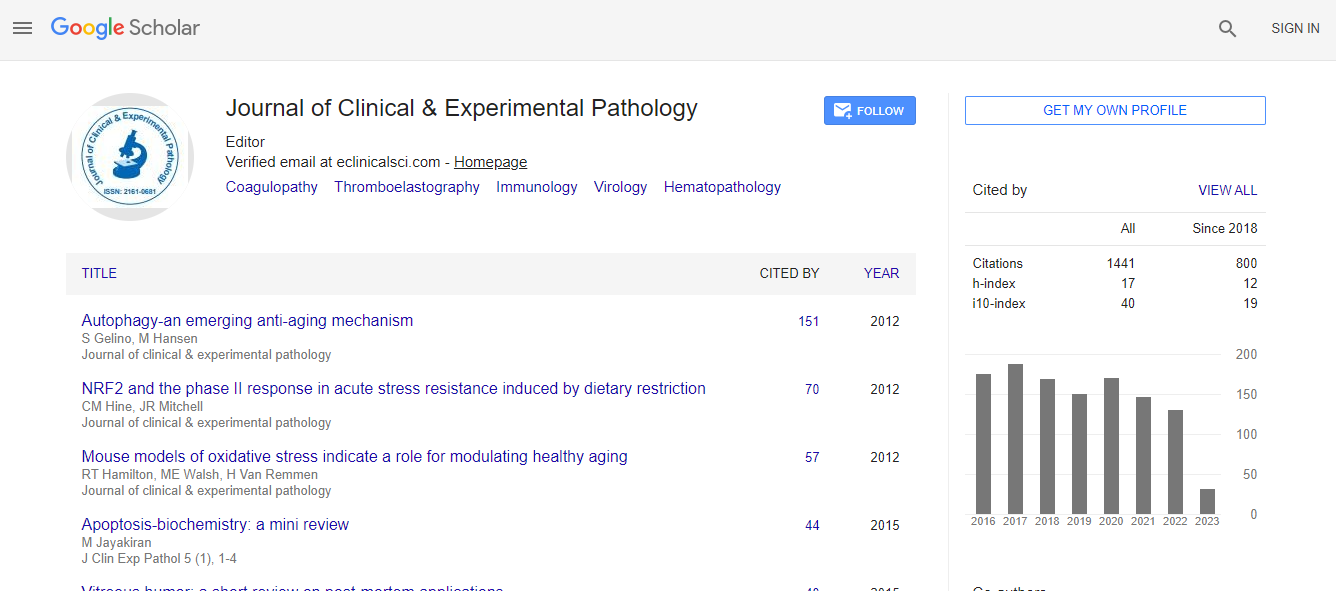
Citations : 2975
Indexed In
- Index Copernicus
- Google Scholar
- Sherpa Romeo
- 天美传媒 J Gate
- Genamics JournalSeek
- JournalTOCs
- Cosmos IF
- Ulrich's Periodicals Directory
- RefSeek
- Directory of Research Journal Indexing (DRJI)
- Hamdard University
- EBSCO A-Z
- OCLC- WorldCat
- Publons
- Geneva Foundation for Medical Education and Research
- Euro Pub
- ICMJE
- world cat
- journal seek genamics
- j-gate
- esji (eurasian scientific journal index)
Useful Links
Recommended Journals
Related Subjects
Share This Page
Escherichia coli O157:H7 infection in dutch belted and New Zealand white rabbits
2nd International Conference and Exhibition on Pathology
Aruna Panda, Ivan Tatarov, Angela R. Melton-Celsa, Krishnan Kolappaswamy, Edwin H. Kriel, Daniel Petkov, Turhan Coksaygan, Sofie Livio, Charles G. McLeod, James P. Nataro, Alison D O?Brien and Louis J DeTolla
Accepted Abstracts: J Clin Exp Pathol
DOI:
