Journal of Biotechnology & Biomaterials
天美传媒 Access
Our Group organises 3000+ Global Events every year across USA, Europe & Asia with support from 1000 more scientific Societies and Publishes 700+ 天美传媒 Access Journals which contains over 50000 eminent personalities, reputed scientists as editorial board members.
天美传媒 Access Journals gaining more Readers and Citations
700 Journals and 15,000,000 Readers Each Journal is getting 25,000+ Readers
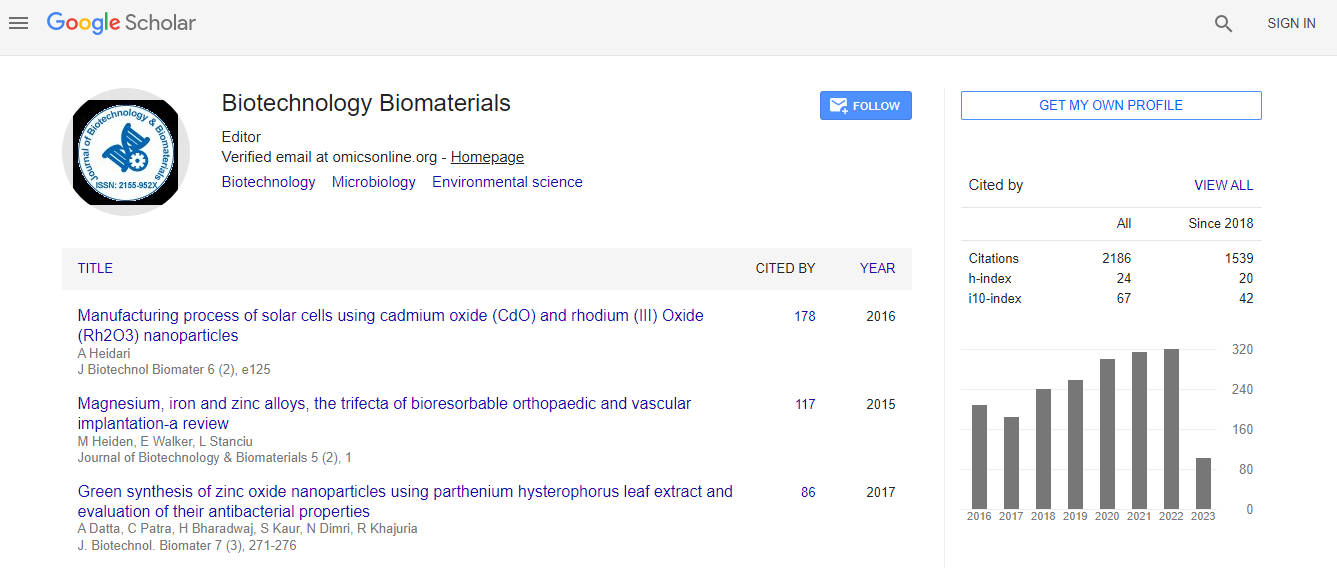
Citations : 3330
Indexed In
- Index Copernicus
- Google Scholar
- Sherpa Romeo
- 天美传媒 J Gate
- Genamics JournalSeek
- Academic Keys
- ResearchBible
- China National Knowledge Infrastructure (CNKI)
- Access to Global Online Research in Agriculture (AGORA)
- Electronic Journals Library
- RefSeek
- Hamdard University
- EBSCO A-Z
- OCLC- WorldCat
- SWB online catalog
- Virtual Library of Biology (vifabio)
- Publons
- Geneva Foundation for Medical Education and Research
- Euro Pub
- ICMJE
Useful Links
Recommended Journals
Related Subjects
Share This Page
In Association with
The influence of growth conditions (temperature and oxygen supply) on manganese(II) sorption by viable and autoclaved Lactococcuslactisvar.lactis NCIMB 6681
8th Euro Biotechnology Congress
Sandra Borkowska-Heurtaux, Colin Hunter and Alistair Sutherland
Glasgow Caledonian University, Scotland
ScientificTracks Abstracts: Biotechnol Biomater
DOI:
Abstract
Manganese(II) is an essential element required for normal growth and development of humans, animals and plants, however it has a tendency to accumulate in some organisms, what leads to higher,potentially toxic, level within the food chain.Mn2+ sorption properties of Lactococcuslactisvar.lactis, a non-pathogenic bacteriumwidely used in the dairy industry were studied as a function of four growth conditions: Cells werecultivated aerobically and with reduced oxygenat 30�?掳C and 37�?掳C. Additionally,biosorption properties of live and autoclaved cells were compared. L. lactis showed very competitive capability to sorb Mn2+ over 5 days and pH drifts in the experimental suspensionsdemonstrated an involvement of ion exchange mechanisms in Mn2+ sorption. Viability of L. lactis during sorption experimentswas studied by serial dilutions and plate count methods with the biggest decrease in a cell numbers observed at 24 and 72 hours contact time. Sorption capacity of live L. lactis cultivated under four different conditions towards Mn(II) ranged 34-50 mg/gdw. Autoclaved biomass showed muchlower sorption capacity (20-39 mg/gdw)but this rangeis among the highest removal capacities towards Mn2+ seen in previous studies using various (non-living) biomasses.The obtained results are the first report showing Mn2+ sorption by viable and autoclaved cells of L. lactis as a function of different growth conditions and metal loadings. It is also among the first work investigating the difference between viable and dead microbial cells.Biography
Sandra Borkowska-Heurtaux completed her BSc (Hons) and MPhil and is afinal year PhDstudent at Glasgow Caledonian University. Currently, she is working on biosorption of manganese and zinc by Lactococcuslactisvar.lactis, Natrinemapallidum, Hydrodictyonreticulatum and Cladophoraglomerata using microbiology and analytical chemistry methods. Prior to beginning the PhD program, she worked as a Research Associate at Edinburgh Napier University. Her work focused on microbial testing to prove efficacy of advanced disinfectant against Pseudomonasaeruginosa, Escherichia coli, Staphylococcusaureus, Enterobacter cloacae and Salmonellatyphimurium. Her areas of interest includemicrobiology, biotechnology,genetics and molecular biology.
